God's eye view
On seeking authenticity in a tourist paradise

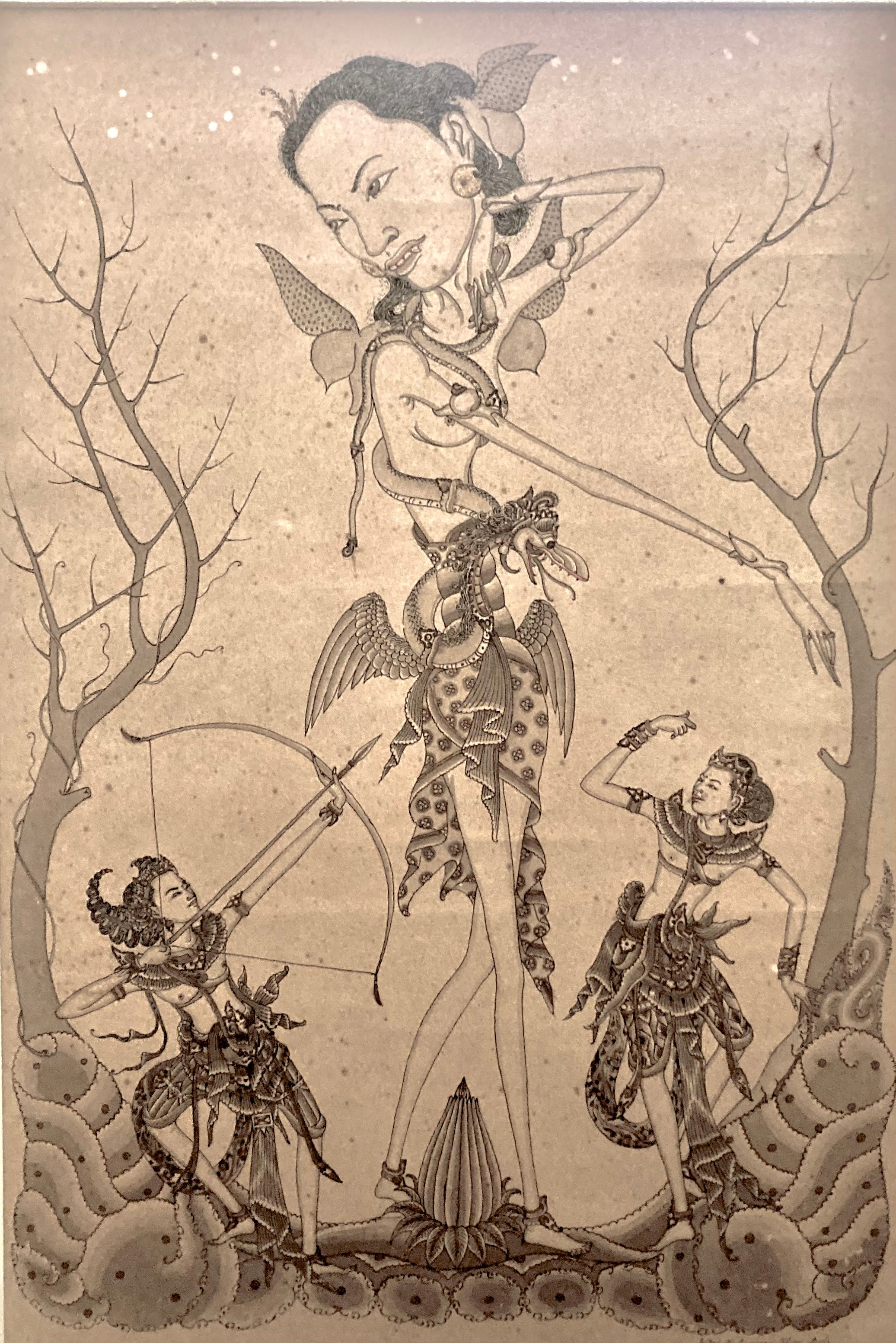
In the Puri Lukisan museum in Bali, the tour guide said there is no clear point of focus in the painting, because it’s from a god’s eye view. The god looks down on the main action, the performance at the lower center of the square in which a woman in headdress kneels and hands something off to a man in headdress, and down on the dancing bearded figures behind her, and the men playing very long wind instruments behind them, but also the woman embracing the man in the audience at bottom, she said, and the man embracing the woman to his chest at right, and that person hiding in what might be a gong or a shield beneath the flag and the temple and the leaves, and the people trading fruits. And also this, she said, pointing to a path along a path in the upper left, where two men are abducting a woman. The god can see that, too.
Notice how not an inch of space is spared, said the tour guide, pointing now to the foliage that fills much of the upper third of the picture: clusters of individually painted leaves sprouting amid the individually painted figures, and temple gates and roof tiles. Her lecture concluded, she nodded and walked toward the exit. The American couple duly followed.
I stood for a beat in the mostly empty room, which was long, and had ceiling fans and clerestory windows. I was quietly excited by the tour guide’s commentary — this idea of a god’s eye view, a perspective on everything all at once. In this view meaning does not converge in a moment’s swell but is cyclical, syncopated like the gamelan performance I saw with my sister the other night: the play of drums and bells repeating and repeating. This is not a land of outstretched distances but ensconcing foliage — wide leaves and vines hanging from banyan trees, humid air, the smoke of incense, and car exhaust.
Outside on the steps, the tour guide handed us snacks wrapped in leaves. I took a bite of a little rice cake, which was sweet. Beyond, landscaped plots of grass meandered down around a small pond, trees and paths toward the entrance gate, which was like two prayer hands drawn apart, said the tour guide.
I came to Bali to meet up with my younger sister, Anna, who signed up for one all-inclusive “Goddess Retreat” allegedly very late one night, in anticipation of her thirty-second birthday. She lives in America and I in Australia, near enough to the island to justify a visit to see her, briefly, before and between her various spa treatments, catered meals and cleansing ceremonies.
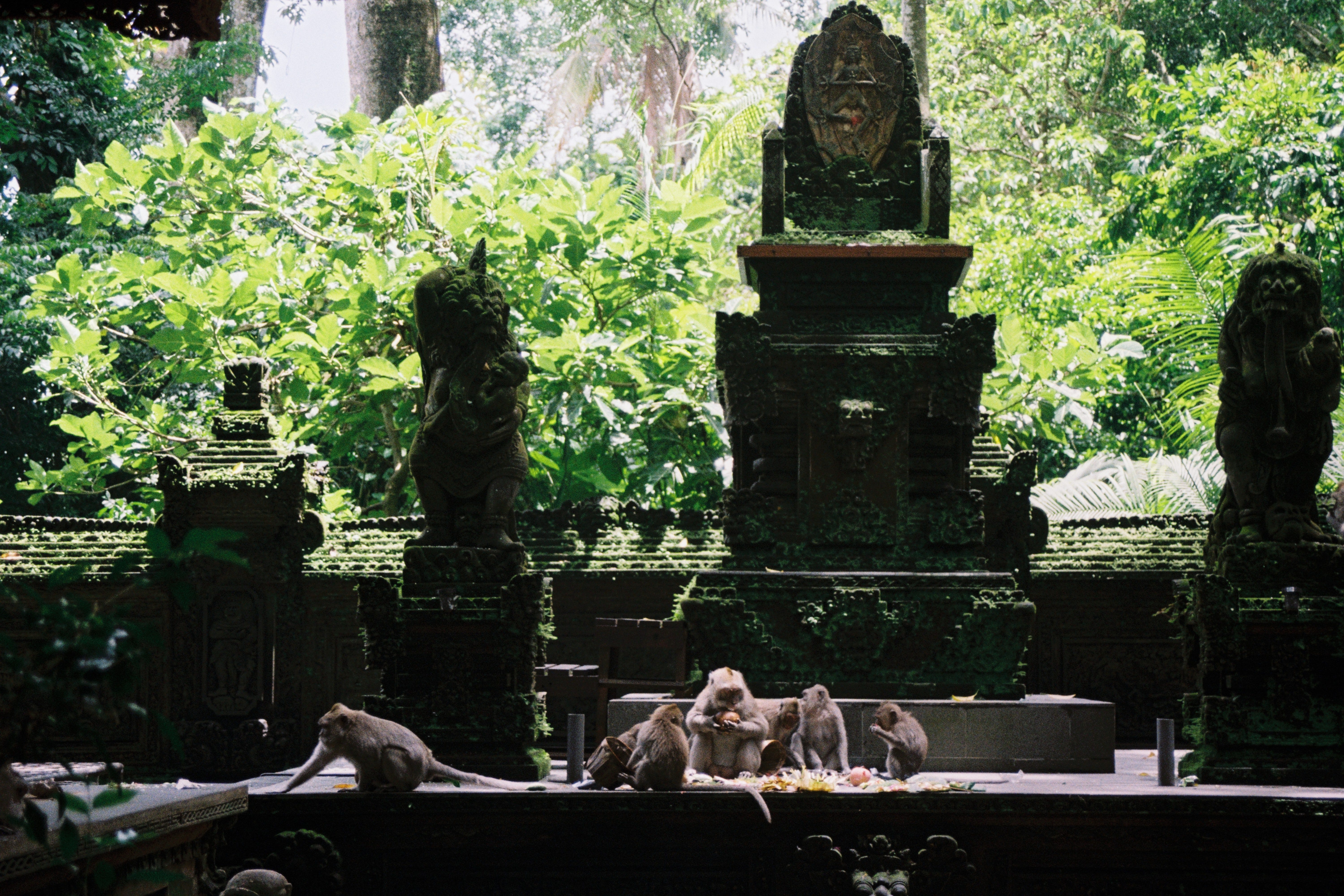
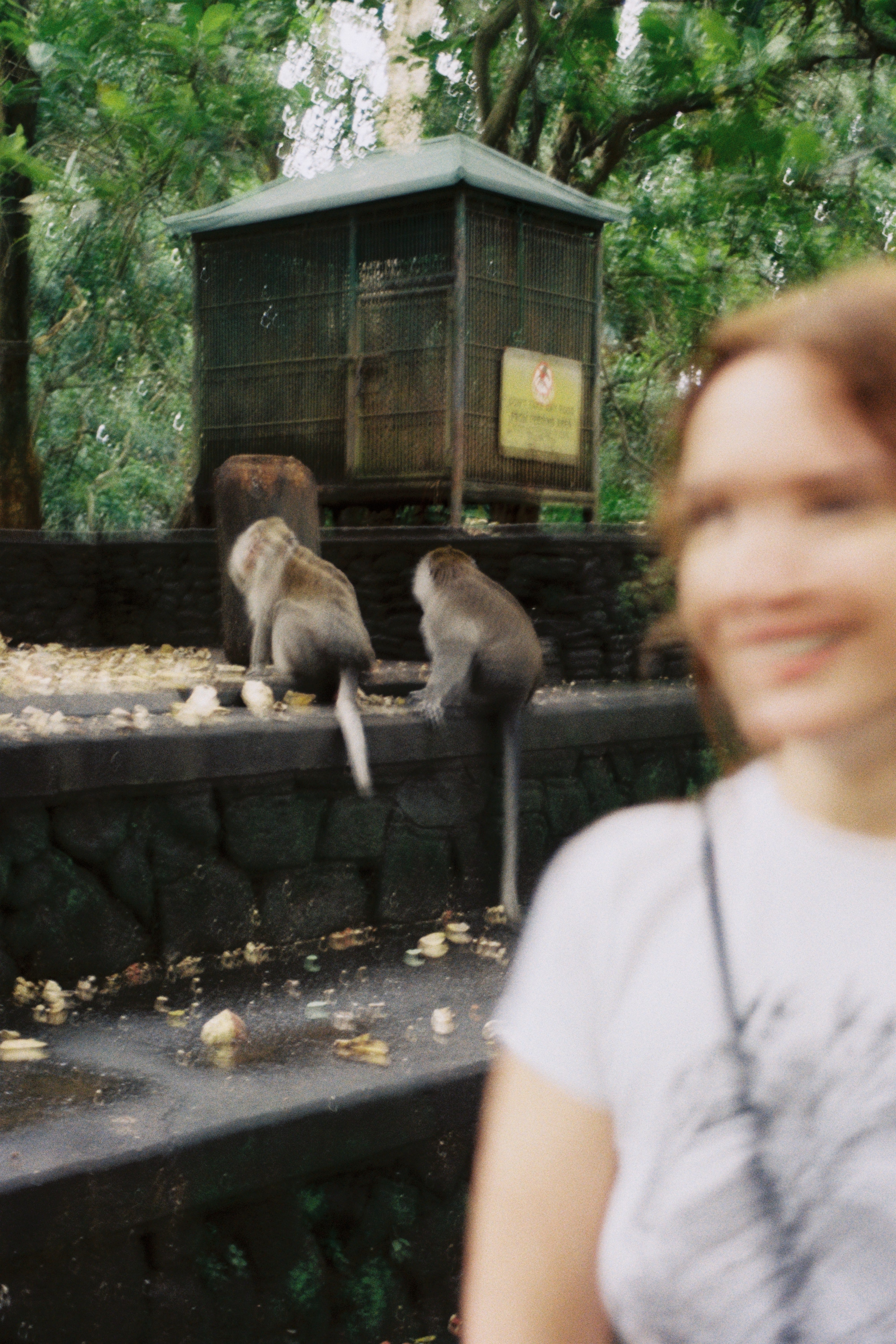
A friend had warned me that Ubud was overrun with tourists, and indeed: as I walked to meet Anna at a café somewhere inside the Sacred Monkey Forest that first morning, I passed a Starbucks, a Haviana’s flip-flop store plus others selling jewelry, and yoga clothes under graphic type-faces and logos printed on plexiglass signs. But I also passed by many temples and stone statues of elephants and monkeys, and women in checkered sarongs holding trays with styled colorful little offerings on woven plates. These offerings held yellow and magenta flower petals, little biscuits, a steaming stick of incense and appeared at the foot of statues, and large trees and little stone niches, and even on the steps of these shops themselves.
For years I had been thinking about the roots of art in religion and ritual, writing about them in the abstract. And here I was in a place where that root had not been cut: ritual was alive, omnipresent, activating even the most quotidian of places with story and purpose, color and smell. But of course I was hardly the first tourist to marvel at this.
As I walked through the monkey forest in search of this mysterious café, I noted a group of monkeys climbing around on a large monkey statue half-covered in moss.
It was my idea to to take the taxi driver up on his offer. On the sidewalk near a busy intersection in Ubud, Anna looked at me with her token combination of acquiescence and skepticism, her hair in a ponytail that was ready for anything.
I approached him and pointed to a Google search result on my phone for the Agung Rai Museum of Art. A large man, he nodded and waved his hand (with worrisome confidence, in retrospect) and shepherded us across the road to a parking lot on the other side.
As the man drove us on, around a bend, past temples and shops, he said something in broken English about art, lots of art, big paintings. Anna and I replied over each other — yes, big paintings, in the museum… “Agung Rai Museum,”I enunciated, again. From the front seat the driver said yes yes, and waved his hand. Soon we were well out of central Ubud, passing shopfronts handprinted signs advertising various trades.
The taxi pulled up in front of a temple building where men sat in white robes on the porch, one of them sitting with a brush over a canvas to the right. This was not the museum. We stepped out all the same, smiling and nodding as the taxi driver ushered us to a guide.
“We’re just going to pretend this is where we were meant to go, ok,” Anna whispered.
“Well it’s not,” I replied to her, smiling, still, to the men in robes, crossing the threshold into the first large room.
“But, whatever.”
Large paintings covered the walls of the first room, which had slick floors and tall vaulted ceiling with wooden beams. The paintings were cheap tricks for tourists, landscapes with clouds or mountains rendered with clever gestures of the brush. A sea of thick impasto pink and yellow flowers, semi-abstract dancers in primary colors, large hyperreal conventionally attractive female faces. Later, I would reflect on how many of these tourist paintings represented a single dramatic moment in time — a sunset, or evening scene, or a dancer mid-step, her robes caught in a breeze. A convention of Western painting, or Western thought, Western time.
Stepping around, I reminded the guide, I was only here to look, only to look. He asked if he could interest me in something small, guiding me to a corner below a step and pointing to stacks of paintings, each a nearly identical variation of abstracted Balinese dancers. I smiled and I shook my head.
I asked the man whether he painted, hoping to make something more of this encounter, something unrelated to a commercial transaction. He told me yes, and I asked him which ones, and he walked me to a series of finely rendered colorful birds on black backgrounds. The canvases rested against a wall. I asked which was his favorite, and he equivocated. I asked how long one of them took him and he equivocated, flitted his hand, said he could offer me a good price.
I thanked the man, and walked on, stopping for a moment to peer through a door into the temple courtyard. Outside, a little offering smoked with incense at the foot of a statue of some female deity, utterly indifferent to my presence as a cashed-up tourist.
It’s funny, I thought to myself, what we designate as art.
* * *
Back at Anna’s accommodation, I lay on the couch facing the glass doors and reflected on what it was about the halls of tourist paintings that I found so absurd. What I came to rather quickly was that the inauthenticity of these paintings and their expressions, their pandering to some version of Western, foreign taste. What I wanted, as a traveler, was an authentic experience, at least in matters of aesthetics and culture. Perhaps my judgements around this were my way of asserting something about who I took myself to be, as a tourist — someone who knows the difference between what is being catered to me and what simply is.
Through the doors, I watched a trio of monkeys wrestle with each other in the grass. Another approached the glass and pressed her little hand to it and bore her little teeth. From inside, Anna pressed her manicured hand to the glass opposite, and we giggled.
* * *
We arrived at the actual Agung Rai Museum a couple of hours later, about thirty minutes before closing and an hour and a half before an evening performance scheduled for the outdoor stage. At the front of the campus, I paid a small, young woman for our tickets. She pointed us through a decorated brick arch toward a campus where we would find the first hall of paintings, she said.
The campus was lush, green and shaded, featuring pathways between a series of palatial buildings of concrete and stone. As well as a museum, the place was a resort, whose offerings were advertised on a screen mounted on a stand at the far end of this courtyard. A loop of music played as a white couple were shown lounging by the pool, dining at the restaurant in slow-motion and walking beneath the lush green trees under which Anna and I now stood.
Inside, the hall was quiet, well-lit, the floors marble, the barn ceiling of rattan and wood. It was a space meant for looking, not buying. My sister and I were the only ones present.
Three paintings in particular caught my eye. First, a portrait, from life, of an Indonesian woman with her hands in her lap, eyes glancing away. 1975. It had the immediacy of an Alice Neel, with a strong sense of drawing, only the colors were washy: muted greens, yellows and reds.
Second, a square painting of a street festival, a tower at center angled slightly, animated as if caught in motion. Crowds of little sketched figures crossed the picture plane at angles in front of the animated tower, and behind, into the sketched-out distance.
And a third painting: a lively semi-abstract expression of a cock fight, in swirls of paint that were witness to the marks of the brush and hard brush-end, perhaps even the artist’s fingers. The bodies of the rooster appeared in one swirling mass that curved out into the swirling surrounds of warm brown-green paint, loose and lively, against the white of the canvas.
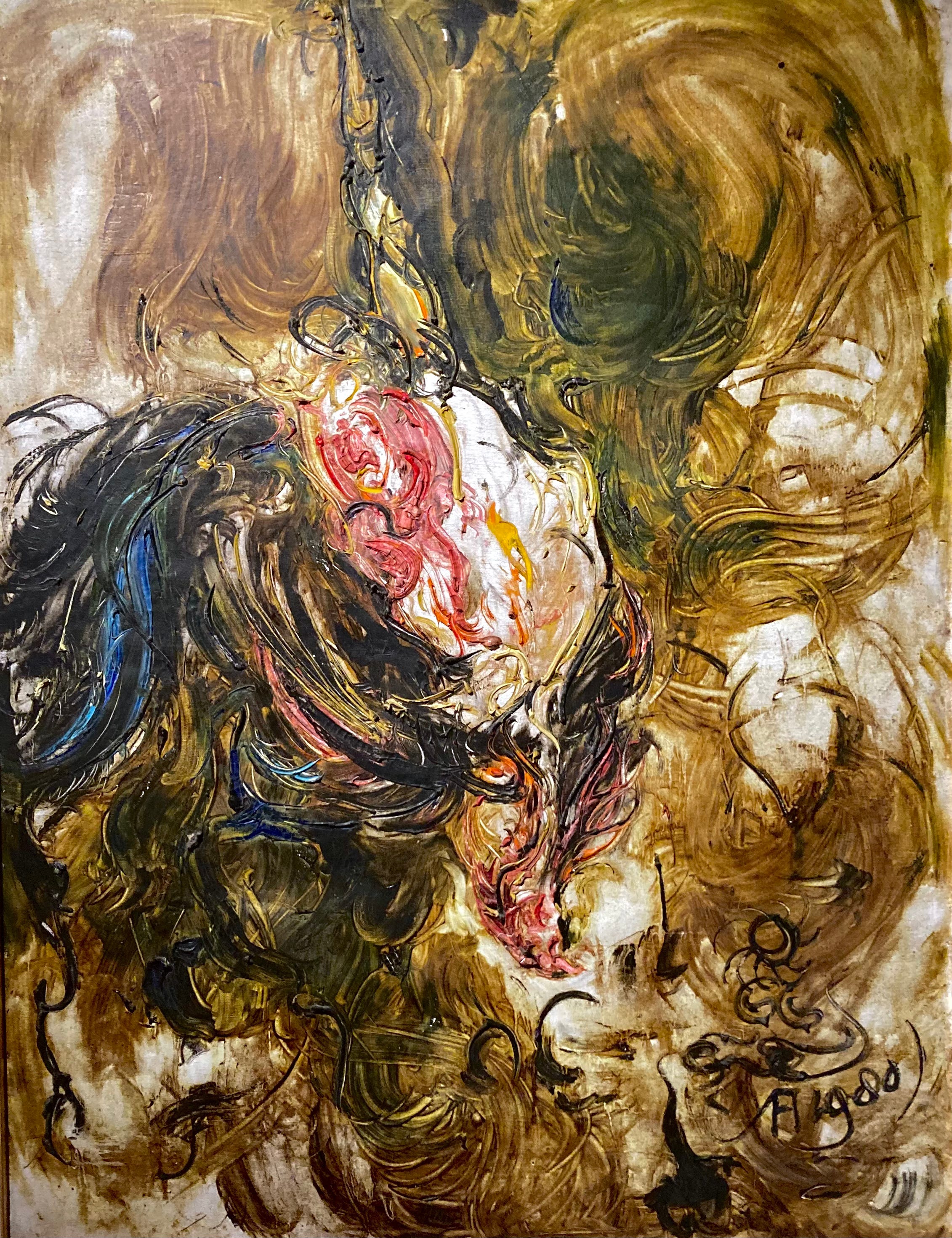
All three felt authentic, that is, painted to express something, something particular. And yet I had to wonder how many local Ubud residents would come here, to this museum within a resort.
Outside on the path, a man in white robes swept the ground of fallen leaves. He smiled big at us, and I smiled back. He noted the other buildings of art to his right, just around the corner. The light now was blueing, the museum soon to close.
Through opulent gilded floral double doors we entered the other gallery. Our movements were quicker, here, as there was more to see and less time. I pointed Anna to a series of large, faded, black-and-white prints featuring Banyan trees, with their webbed trunks, their tall hanging vines.
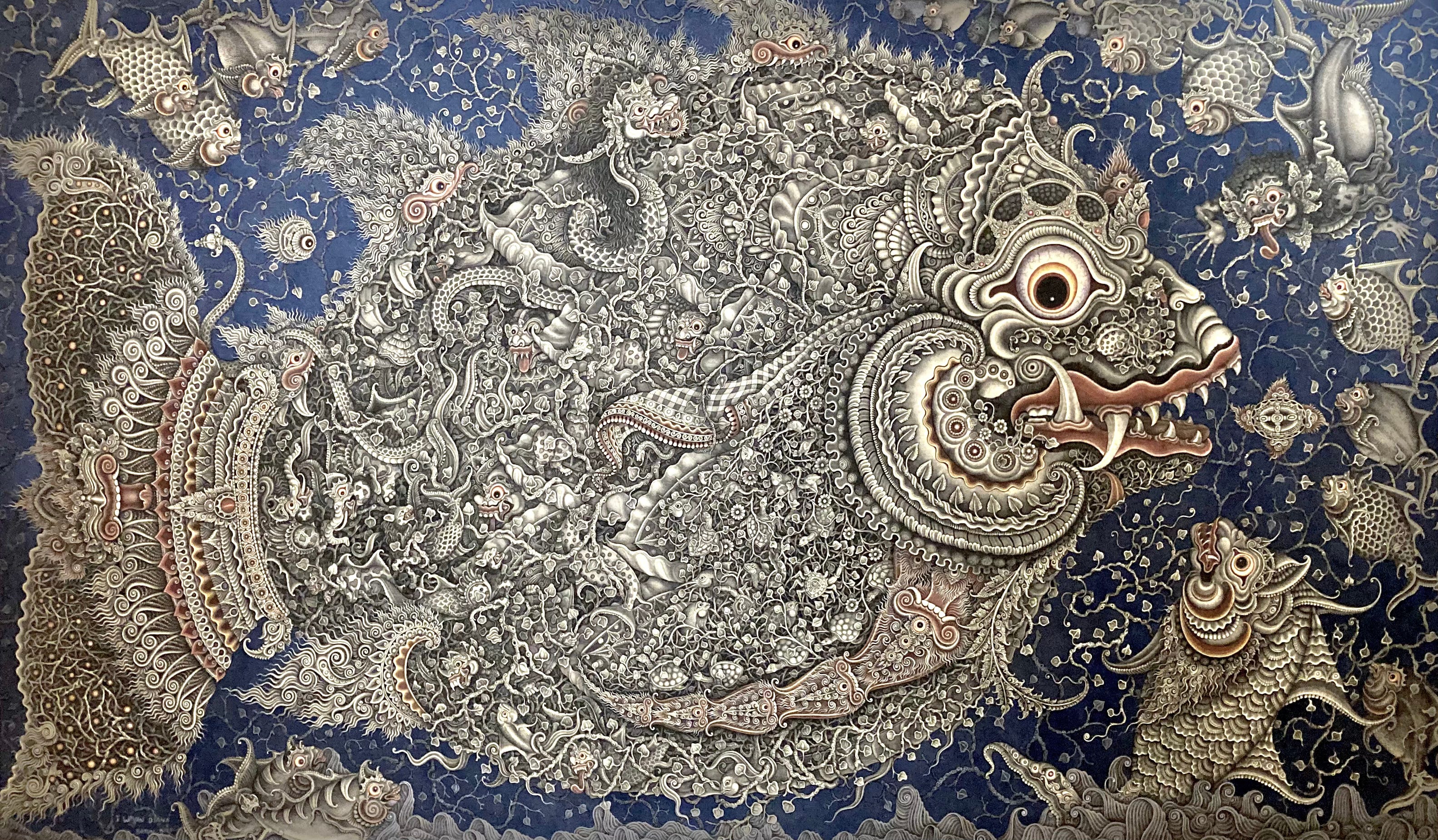
Other images on the walls appeared less the work of an individual artist, and more that of a culture. For example: an ink painting of a fearsome fish or fish-spirit, fanged, its body composed of intricate botanical patterns, and curling sweeps of fabric and other fearsome little faces, black and white and rimmed with a bit of red. Around, intricate tangles of vines and other miniature fearsome fishes on the blue backdrop. The whole pictorial space was filled.
In the minutes before closing, I quickly stepped through the portal of a projection room to see what was in the back. More drawings on walls, wooden sculptures and costumes too.
I was charmed when I saw it: the little offering of flower petals, chopped greenery and biscuits placed on a bed of woven reeds on a table in front of a large costume of the Barong, king of the spirits — its eyes big and round, mouth almost smiling, face couched in gilded mirrored textiles and long multi-colored fur.
It was curious to see that offering inside the gallery. It designated the Barong costume as something of a different order than the other sculptures and the pictures on the wall. It was the opposite of an autonomous work of art, separate from the world, valuable in of itself. It was as if the costume were invested with a spirit that needed to be honored or appeased.
* * *
The sky was dark above the palms and banyan trees as my sister and I watched the Barong come alive. We were seated in a front row of plastic seats facing a slightly elevated stone stage where men sat at their gilded xylophone booths, knocking out bell-like notes with hammers, jangling, syncopated, in cyclical fashion. Through the opulent brick arch at the center of the stage, the Barong paraded out, inhabited by two pairs of feet which swayed in unison, the head and the back twisting, making gestures befitting its fearsome face.
At some point, children dressed as monkeys jumped out and growled at the audience through masks. And at some point the Barong angled in such a way that I could see the hands holding the mask through the costume, turning the mask this way and that.
Vines of the banyan trees glowed in the artificial stage lights. Somewhere not far from us, the monkeys were doing what monkeys do, wrestling and pounding stones in puddles and picking fleas from each other’s fur before sleep. And here, I thought, here is what the humans do: dress up in costumes of monkeys and sprits, knock surfaces to make music, and make paintings, and look at paintings on walls.
* * *
In the end, the most “authentic,” unmediated, moment of my trip had little to do with traditional Balinese culture. It was on the back of a motorbike, as I was riding back to my accommodation from a visit to a local waterfall. Through the helmet, which the driver handed me before I mounted, I heard a bit of fuzz, then lo, over an intercom a young man was asking me how I was.
“Fine, thanks,” I said, a smile in my voice.
He told me he wanted to practice his English — which was good, I told him. I told him I only knew one phrase in Indonesian, and that was “Terima Kasih,” or thank you. He asked how long I was staying in Bali, and I told him just one week.
“One week only!”
“Yes, one week only.”
“You have a nice speaking voice,” he said. “Do you sing?”
“Only in the shower,” I told him. “My mother and her siblings all sing though — together, sometimes.”
He asked what kind of music I liked. I hesitated then said “Broken Social Scene” which is the answer I gave the last time anyone was asking me what music I liked, which was when I was last single, which was 2017.
“Can you sing it?” He said. I laughed — imagined for a split-second singing “Shoreline” — then told him no.
“Mind if I practice singing,” he said. More amicable chuckles from my end. “Not at all!” I said.
And so there I was, zooming through Bali, past homes and temples and clusters of tall trees and shrines as this young man crooned. I confirmed this later by googling the lyrics — it was The Man Who Can’t Be Moved, by the British band The Script (2008). A sort of Ed-Sheeren-esque song of a hopeless romantic, who pledges to wait for the woman he loves, god help him, at the bottom of her street.
Outside the Puri Lakisan Museum the guide had spoken about the expectations of women to maintain the family line, the complications around dating someone from a lower caste, and age 25 as a sort of cut-off point for youth.
After I dismounted the motorbike and handed the helmet back, it occurred to me that maybe Western pop music, with its celebration of romance and the individual, was an escape for young people whose culture asked them to conform.
It struck me, as well, that I never saw his face.